The Churning of the Ocean in the Vishnu Purana
The churning of the ocean, or Samudra Manthan, is one of the most vivid and enduring episodes in Hindu sacred storytelling. In the Vishnu Purana, it is not simply a contest for a magical drink. It is a turning-point in the relationship between gods, demons and the preserving power of Vishnu, and a story in which cooperation, rivalry, danger and divine intervention all appear at once.
The crisis that sets the story in motion
In the principal retelling in the Vishnu Purana, the gods have been weakened after a curse from the sage Durvasa, and the demons, or asuras, gain the upper hand. The gods turn to Vishnu for help. He advises them to churn the ocean of milk, the cosmic sea, so that the nectar of immortality, amrita, may be recovered. This is a story about recovery rather than conquest: the gods do not simply overpower their rivals, but seek a means to restore their strength and cosmic balance. The episode appears in Book 1, chapter 9 of Horace Hayman Wilson’s translation of the Vishnu Purana.
The set-up also reveals something important about the text’s religious outlook. The Vishnu Purana presents Vishnu as the sustaining deity who guides events when divine order is threatened, but it does not erase the other figures in the story. The gods, demons, sages and cosmic beings all have distinct roles. The narrative is therefore not a simple morality tale about absolute good and evil; it is a mythic account of how power, duty and survival are negotiated in a cosmic struggle.
Mandara, Vasuki and the labour of churning
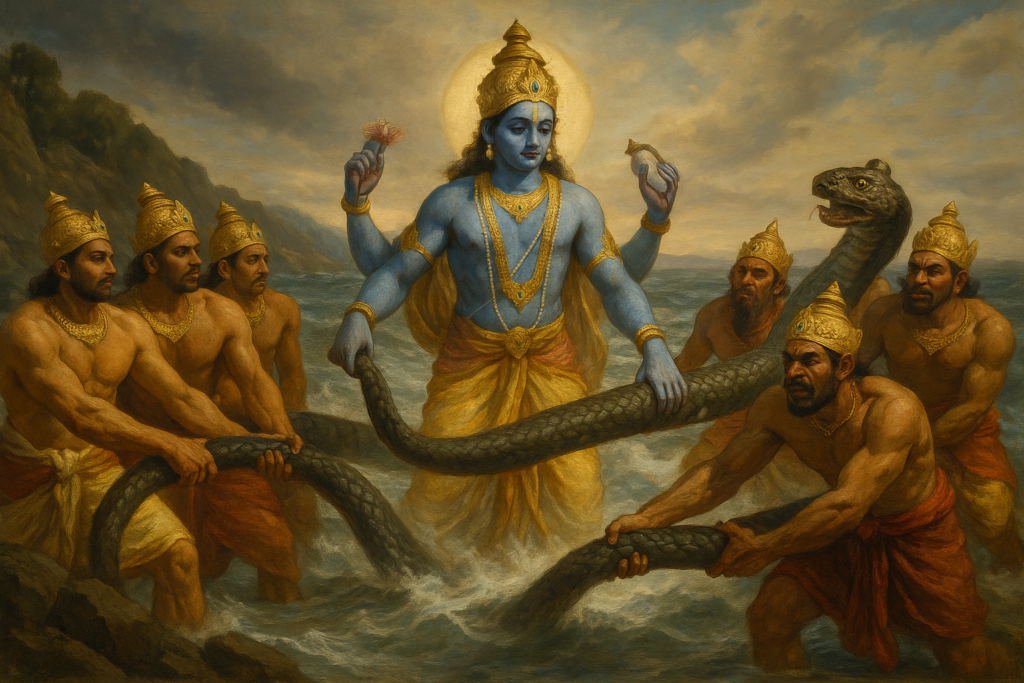
To churn the ocean, the gods and demons use Mount Mandara as the churning-stick and the serpent Vasuki as the rope. Vishnu himself appears in several supportive forms in the process. In the Vishnu Purana, he is present as the tortoise Kurma beneath the mountain, giving it a stable foundation, and he also strengthens the participants so that the churning can continue. The gods take one end of Vasuki, the demons the other, and the mountain begins to turn in the great waters.
The image is striking because it joins violence and cooperation. The demons are not absent from the work; they are necessary to it. Yet the task is also punishing. Vasuki’s breath scorches the demons at one end and cools the gods at the other, a vivid detail in Wilson’s translation that reinforces the unequal strain involved. The ocean yields its contents only through immense effort.
Before the nectar appears, other treasures emerge from the sea. Different Sanskrit tellings list them somewhat differently, but the core idea is stable: the ocean produces marvels, signs of abundance and cosmic richness, before revealing the prize everyone desires most. In the Vishnu Purana, the sequence leads ultimately to the appearance of Lakshmi, goddess of fortune and prosperity, followed later by the nectar of immortality itself.
Poison first, then nectar
One of the most famous moments in the wider Samudra Manthan tradition is the emergence of a deadly poison, which threatens to destroy the world unless Shiva drinks it. That episode is central in several later and related tellings, but it is not a prominent feature of the chapter in the Vishnu Purana used here as the main source. In this text, the focus stays on the divine recovery of order, the surfacing of treasures and the eventual appearance of amrita. This is a useful reminder that not every version of the story contains every well-known scene.
That distinction matters because the churning story circulates across Hindu literature. It is referred to in the epics and other Puranic works, but each text emphasises different features. The Vishnu Purana gives the episode a particularly important place in its theological world, since Vishnu’s guidance frames the whole event. Other versions expand the catalogue of treasures, add the poison, or develop the role of Mohini, Vishnu’s female form, in more detail. In the Vishnu Purana, however, Mohini appears only briefly, and the text does not fully develop the later, popular scene of her distributing the nectar.
Lakshmi rises from the sea
Among the treasures that emerge is Lakshmi, who becomes especially important in Vishnu-oriented traditions as his consort and as a goddess associated with beauty, prosperity and auspiciousness. The Vishnu Purana celebrates her appearance in language of praise. In the story’s logic, she is not just a prize produced by the churning; she is a divine presence whose arrival marks the restoration of fortune itself. Later art often gives her a prominent visual role. A seventh-century bronze in the Metropolitan Museum of Art, for example, shows Lakshmi enthroned as a figure of abundance, illustrating how deeply her image took hold in South Asian religious culture.
It is worth underlining that Lakshmi’s place in the narrative is not identical in every tradition. Some communities and texts present her as inseparable from Vishnu; others emphasise different aspects of her character and worship. The Vishnu Purana reflects a particular devotional perspective, one in which Lakshmi’s emergence from the ocean confirms the saving and ordering role of Vishnu and the auspicious character of his presence. That should be read as the text’s theology, not as a claim that all Hindu traditions interpret her in exactly the same way.
Why the gods need Vishnu’s intervention
Once amrita appears, the gods and demons immediately struggle over it. The gods need immortality to recover their strength, while the demons see the nectar as the means to secure victory. The story’s tension lies in that moment of shared labour followed by instant rivalry. Cooperation proves necessary to obtain the treasure, but trust is not enough to divide it. Vishnu’s intervention ensures that the gods receive the nectar, preserving their cosmic role.
In the broader religious imagination, the scene has often been read as a story about endurance and discernment: great gifts are won only through collective effort, but the possession of those gifts requires wisdom as well as power. For devotees in traditions centred on Vishnu, the episode also reinforces his role as protector and restorer. For readers today, the appeal of the story lies in its scale. It takes place on a cosmic stage, yet its drama is recognisably human: work hard, remain alert, and do not assume that everyone who pulls on the same rope shares the same aim.
A story that travelled widely
The churning of the ocean became one of the most widely represented scenes in South Asian art. Painted, carved and printed versions often show the mountain, the serpent and the struggle of the divine participants in a single crowded image. A Met Museum painting from the Punjab Hills, for example, depicts the episode as a richly layered scene, evidence of how the narrative moved far beyond text into visual devotion and courtly art. The story’s appeal clearly lay in its mixture of spectacle and meaning: it is at once a cosmic event, a devotional image and a tale of hard-won renewal.
For that reason, the Vishnu Purana episode remains memorable even when retold briefly. It combines the architecture of a myth with the logic of ritual labour: a mountain becomes a churn, a serpent becomes a rope, and the sea yields both peril and blessing. The result is one of the most elegant and influential stories in Hindu literature, still compelling because it understands that the making of order is never effortless.