Ganesha and the Breaking of the Tusk: The Story Behind the Scribe of the Mahabharata
Ganesha is one of the most recognisable figures in Hindu tradition: elephant-headed, pot-bellied, and associated with new beginnings, learning and the removal of obstacles. Yet one of the best-known details in his iconography is also one of the most moving in the literature around him: the broken tusk. In the story of how Ganesha became the scribe of the Mahabharata, that missing tusk is not a decorative flourish. It is part of the drama of a sacred epic being committed to writing, and of a god’s willingness to sacrifice something of himself for the sake of knowledge.
Who Ganesha is in the epic imagination
Ganesha, also called Ganapati, appears in many Hindu traditions as the deity invoked at the start of undertakings, especially those connected with learning, ritual and auspicious beginnings. His rise in Hindu art and devotion is gradual and varied, but by the time of the classical and post-classical periods he is firmly established as a widely beloved god. Museum collections and exhibition catalogues show how his familiar attributes developed over time: the elephant head, the sweetmeats, the goad, the noose, and eventually the broken tusk. Not every image carries the same objects, which is a reminder that Hindu iconography is diverse rather than fixed.
The story of Ganesha writing the Mahabharata belongs to the epic’s own frame narrative. It is not a Vedic tale, and it should not be confused with older Vedic deities. In the Mahabharata itself, the account is placed at the very beginning of the Adi Parva, the first book of the epic, where the poem explains how it came to be written down.
Vyasa needs a scribe
In the Mahabharata’s opening narration, the sage Vyasa—also known as Krishna Dvaipayana Vyasa—is preparing to compose the great poem. He is the traditional compiler of the Mahabharata, though scholars distinguish this literary persona from any historical author in the modern sense. In the epic’s own telling, Vyasa has conceived the work in his mind and now needs someone able to record it.
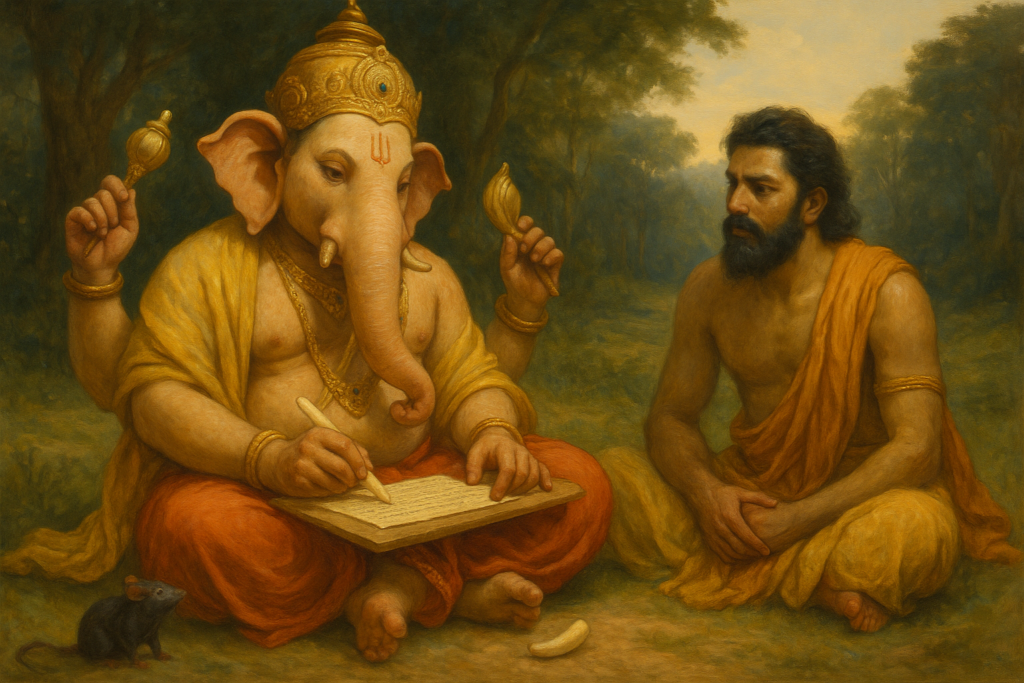
According to the text, Brahma advises Vyasa to think of Ganesha for this task. Vyasa does so, and Ganesha appears. Vyasa then asks him to serve as the writer of the Bharata. Ganesha agrees, but on one condition: his pen must not stop, even for a moment. Vyasa accepts, and makes his own counter-condition. Whenever Ganesha encounters a passage he does not understand, he must pause before continuing to write.
This compact exchange does a great deal of narrative work. It presents the epic as both divine and literary: inspired by Vyasa, but physically written by Ganesha. It also creates a stylised image of composition itself. The Mahabharata is not merely being copied; it is being composed through a live intellectual contest between speed and depth, between the flow of dictation and the complexity of thought.
The broken tusk and the race between thought and writing
From there the story turns to the famous broken tusk. Ganesha writes as Vyasa dictates, but Vyasa deliberately crafts difficult passages so that the scribe must pause and reflect before continuing. This allows Vyasa time to formulate the next sections of the poem. The result is a delicate balance: Ganesha must remain steady enough to preserve the uninterrupted flow, while Vyasa must be clever enough to keep pace.
At one point, the writing instrument breaks. In the Mahabharata’s own account, Ganesha snaps off one of his tusks and uses it as a substitute pen, so that he can keep to his promise not to stop writing. This is the key moment behind his broken-tusk image. The gesture is memorable because it transforms an injury into an act of devotion and concentration. The tusk becomes a sign not only of Ganesha’s form, but of his commitment to the work in hand.
Different Hindu texts and later tellings sometimes add their own accents to the episode, but the Mahabharata’s opening frame is the principal source for the scribe story. Some later traditions expand the tale with further detail or devotional interpretation; others use the broken tusk more as a symbolic emblem than as a narrated event. What remains consistent is the association between Ganesha, writing, and the sacrifice required to preserve sacred learning.
Why the Mahabharata makes Ganesha its writer
The choice of Ganesha as scribe is fitting for several reasons. He is commonly associated with beginnings, memory and the successful completion of tasks. He is also a deity of thresholds and obstacles, which makes him a natural figure to invoke at the opening of a monumental undertaking. In the epic’s literary imagination, the Mahabharata itself is such an undertaking: vast, difficult and full of interwoven narrative strands.
The story also reflects a broader Indian reverence for disciplined learning. The epic is not presented as casual storytelling. It is a text that requires care, concentration and respect. Ganesha’s willingness to keep writing, even at the cost of his tusk, makes that seriousness visible in physical form. The broken tusk is therefore not an accident left over from a battle or a wound of humiliation; it becomes a deliberate mark of service.
How the image took on a life of its own
Over time, the broken tusk became one of Ganesha’s most recognisable attributes in sculpture, painting and ritual art. In many images he holds it openly; in others it is implied or omitted, depending on region, period and artistic convention. Some early depictions of Ganesha do not yet show all the later features that become standard in temple and domestic worship. This matters, because it shows that iconography evolved alongside devotion rather than arriving fully formed.
The tusk also entered the realm of interpretation. For some devotees and later writers, it suggests self-control, the renunciation of pride, or the willingness to give up something of oneself for a higher purpose. Such readings are devotional interpretations rather than the only meaning of the image, and they should not be treated as universal across all Hindu communities. Still, they help explain why the broken tusk has remained such a powerful emblem: it is at once a story detail, a ritual sign, and a visual shorthand for dedication.
Reading the story with care
Because Ganesha is beloved across many Hindu traditions, the story of the Mahabharata scribe has travelled widely and acquired many layers of meaning. Yet the central narrative remains beautifully simple. Vyasa has a vast epic to set down. Ganesha agrees to write it, on the condition that the dictation never stops and the writing never falters. When the pen breaks, he sacrifices part of himself to keep the poem moving. The result is not merely a myth about a god with an unusual face, but a meditation on how knowledge is preserved: by concentration, discipline and willingness to bear a cost.
That is why the broken tusk still matters. It is not only an explanation for an image. It is a story about the making of one of South Asia’s greatest texts, and about the quiet heroism of continuing when the task demands more than ease or elegance.
Sources and further reading
- The Mahabharata, Book 1: Adi Parva, translated by Kisari Mohan Ganguli (opens in a new tab)
- Ancient India: living traditions, British Museum (opens in a new tab)
- Ganesha: Lord of New Beginnings, The Metropolitan Museum of Art (opens in a new tab)
- “Gaṇeśa in the Mahābhārata,” Journal of the Royal Asiatic Society (opens in a new tab)